
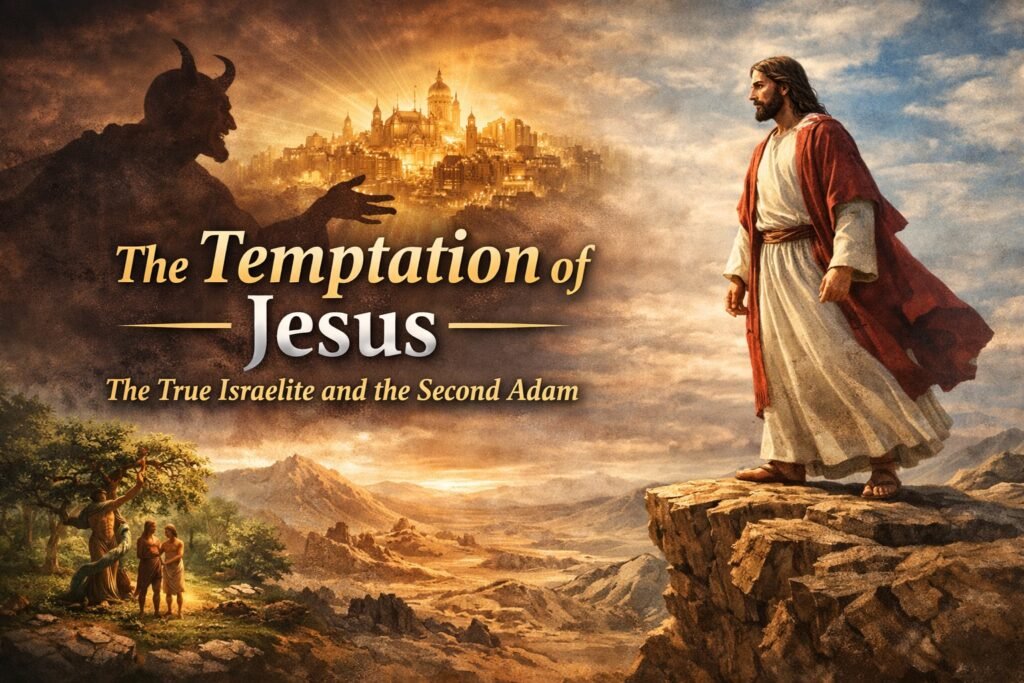
The Temptation of Jesus — The True Israelite and the Second Adam
Luke 4:1–13
1. Context and Theological Framework
Luke 4:1–13 follows immediately after Jesus’ baptism (Luke 3:21–22), where He is publicly affirmed as the Son of God. Now that Sonship is tested.
Jesus is:
- Filled with the Holy Spirit (empowerment)
- Led by the Spirit (divine orchestration)
- Brought into the wilderness (a place of testing, not accident)
Key Principle:
This event is not random—it is the will and providence of God. God intended this testing (1 Corinthians 10:13; Deuteronomy 8:2–3).
2. Verse 1 — The Leading of the Spirit
Greek: ἤγετο (ēgeto) — imperfect passive of ἄγω
Meaning: “was being led” (continuous action)
The imperfect tense shows ongoing leading over the forty days. Jesus is not wandering; He is continually directed by the Spirit.
This parallels Israel. The nation did not wander aimlessly for 40 years—it was guided (Numbers 9:15–23).
3. Verse 2 — The Forty Days
Typology:
- Jesus: 40 days
- Israel: 40 years
Both experience wilderness, hunger, and testing.
Where Israel failed, Jesus succeeds.
Key texts:
- Deuteronomy 8:3
- Exodus 16 (manna)
God allowed hunger intentionally. Therefore, for Jesus to create bread would have been disobedience, not provision.
4. Jesus as the True Israelite
- Isaiah 42:1–4
- Isaiah 49:3
The Servant is called “Israel.”
The Messiah embodies what the nation failed to be.
Jesus fulfills Israel’s calling perfectly.
5. First Temptation — Luke 4:3–4
Category: Lust of the flesh
Greek Condition:
εἰ υἱὸς εἶ τοῦ θεοῦ → “Since You are the Son of God”
This is not doubt—it is a challenge.
Commands:
- εἰπὲ (eipe) — aorist imperative (“Speak now”)
- γενηθήτω (genēthētō) — aorist imperative (“Become”)
These convey decisive, immediate authority.
Core Temptation:
Act independently of the Father’s will.
Jesus responds with Deuteronomy 8:3.
Greek: ὁ ἄνθρωπος (ho anthrōpos) — “the man”
This shifts from Israel corporately to the individual: every person lives by the Word of God.
6. Second Temptation — Luke 4:5–8
Category: Lust of the eyes
Greek: στιγμῇ (stigmē) — “moment” (used only here)
This indicates an instantaneous, supernatural display of all kingdoms.
This is external and real—not internal or psychological.
7. Satan’s Claim of Authority
Satan states:
- The kingdoms are his
- They were handed over to him
- He gives them to whom he wishes
Biblical correlation:
- 2 Corinthians 4:4
- Ephesians 2:2
- John 12:31
This authority stems from Genesis 3. Humanity forfeited dominion, giving Satan temporary influence.
8. The Messianic Shortcut
Satan offers Jesus the kingdom without the cross.
If accepted:
- No atonement
- No salvation
- No restoration
Key Truth:
All restoration pivots on the cross.
9. Antichrist Parallel — Revelation 13:2
“The dragon gave him his power, his throne, and great authority.”
Contrast:
- Jesus rejects Satan’s offer
- The Antichrist accepts it
This reveals a counterfeit messianic pattern: a false son empowered by Satan.
10. Jesus’ Response — Luke 4:8
Greek: προσκυνήσεις (proskunēseis) — aorist (worship)
The aorist indicates a decisive, irreversible act.
If Jesus had worshiped Satan, it would have been final—no repentance possible.
Parallel:
- Revelation 14:9–11
Satan is effectively asking God the Son to declare Satan as God—cosmic rebellion at its highest level.
11. Third Temptation — Luke 4:9–12
Category: Pride of life
Jesus is physically taken to Jerusalem and placed on the temple.
This is a real, physical event—not a vision.
Satan quotes Psalm 91—but misuses Scripture.
Old Testament Parallel:
- Exodus 17:1–7 — “Is the Lord among us or not?”
This temptation is about testing God rather than trusting Him.
12. Nature of the Temptation
- Public spectacle
- Forced divine intervention
- Glory without obedience
Jesus responds with Deuteronomy 6:16:
“You shall not put the Lord your God to the test.”
13. Why Deuteronomy?
All three responses come from Deuteronomy 6–8.
These chapters recount Israel’s wilderness failure and call for covenant faithfulness.
Jesus relives Israel’s test—and succeeds.
14. Verse 13 — Conclusion
“When the devil had finished every temptation…”
This indicates more temptations occurred than recorded.
These three represent all categories of temptation.
“Until an opportune time” shows Satan will return—often more subtly (John 6:15; ongoing opposition leading to the cross).
15. The Threefold Pattern — 1 John 2:16
| Category | Jesus | Israel | Adam |
|---|---|---|---|
| Lust of the flesh | Pass | Fail | Fail |
| Lust of the eyes | Pass | Fail | Fail |
| Pride of life | Pass | Fail | Fail |
16. Jesus as the Second Adam — Final Summary
| Adam | Jesus |
|---|---|
| Garden | Wilderness |
| Surrounded by abundance | Surrounded by deprivation |
| Disobeyed | Obeyed |
| Brought death | Brings life |
Central Theological Conclusion
Jesus is:
- The True Israelite (Isaiah 42; 49)
- The Second Adam (Genesis 3 reversal)
- The Faithful Son who obeys where all others failed
Central Truth:
Jesus did not merely resist temptation—He secured victory.
Israel failed.
Adam failed.
Humanity fails.
Jesus stands.
Application:
Victory over temptation is found in submission to the Word of God and alignment with the will of the Father.