
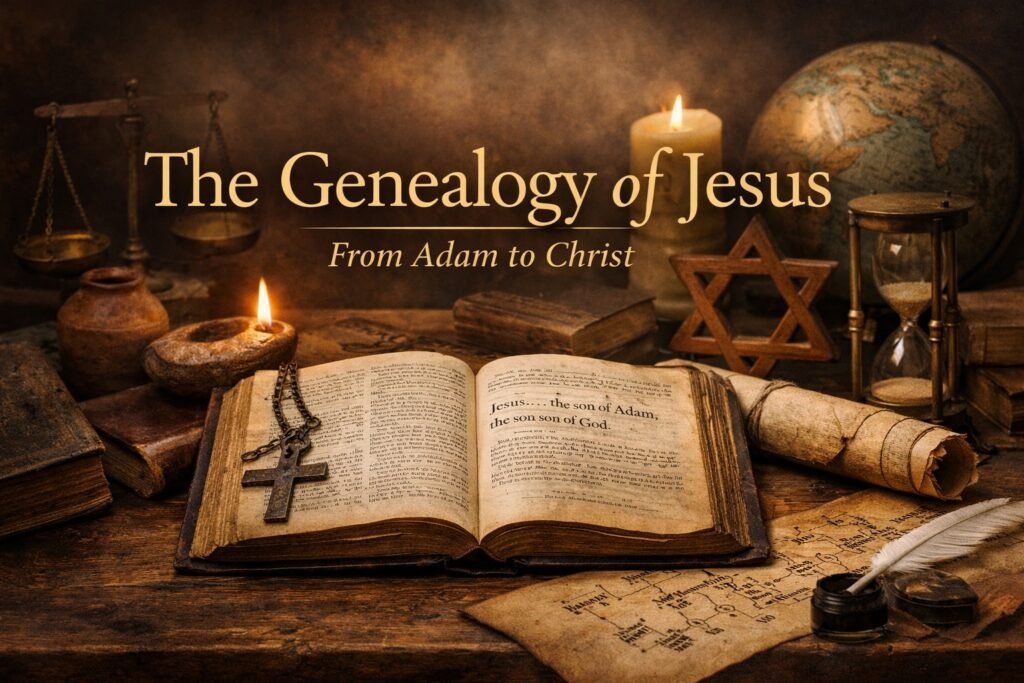
Text: Luke 3:23–38 (NASB 1995)
1. Introduction
Luke 3:23–38 presents the genealogy of Jesus in a form that is both historical and theological. Unlike Matthew, Luke traces the lineage backward, moving from Jesus all the way to Adam, and ultimately to God.
Luke 3:23 — “When He began His ministry, Jesus Himself was about thirty years of age, being, as was supposed (ἐνομίζετο), the son of Joseph…”
2. Key Structural Observations
A. Direction and Scope
Matthew 1:1–17 → Abraham → Jesus (Jewish focus)
Luke 3:23–38 → Jesus → Adam → God (universal focus)
B. Genealogical Emphasis
Matthew → Royal/legal line (through Solomon)
Luke → Biological/universal line (through Nathan)
C. Starting Point
Jesus begins ministry at about 30 years old (Luke 3:23), aligning with priestly service age (Numbers 4:3).
3. Important Greek Observation
The Phrase “as was supposed”
Greek: ἐνομίζετο (imperfect passive of νομίζω)
Meaning: “was continually supposed”
Implication:
This reflects an ongoing public assumption. Jesus was legally associated with Joseph, but not biologically.
4. The Line from David
A. Two Distinct Lines
Matthew → Solomon (royal line)
Luke → Nathan (non-royal line)
B. Significance
Matthew establishes Jesus’ legal right to the throne.
Luke traces His human lineage apart from royal succession.
This avoids the curse of Jehoiachin (Jeremiah 22:24–30; cf. Matthew 1:12).
C. Key Insight
After David:
Matthew’s line → kings (Hezekiah, Josiah, etc.)
Luke’s line → non-royal individuals
5. Notable Individuals in Luke’s Genealogy
A. Zerubbabel and Shealtiel (Luke 3:27)
Also referenced in Ezra 3:2, Haggai 1:1, Zechariah 4:6–10.
Associated with post-exilic restoration.
B. Perez (Luke 3:33)
Genesis 38:29 — son of Judah and Tamar.
The Messianic line includes morally complex history.
C. Enoch (Luke 3:37)
Genesis 5:24 — “God took him.”
Jude 1:14–15 — identified as a prophet.
He walked with God and did not experience death.
D. Methuselah (Luke 3:37)
Traditionally understood meaning: “When he dies, it shall come.”
Associated with the timing of the Flood (Genesis 7:6–11).
E. Lamech (Luke 3:36)
Genesis 5:28–29 — father of Noah.
Distinct from Cain’s Lamech (Genesis 4:19–24).
6. Genealogical Consistency with Genesis
A. Genesis 11 Alignment
Luke 3:34–36 parallels Genesis 11:10–26:
Shem → Arphaxad → Shelah → Eber → Peleg → Reu → Serug → Nahor → Terah → Abraham
B. Lifespan Decline
Noah — 950 years (Genesis 9:29)
Shem — 600 years (Genesis 11:10–11)
Abraham — 175 years (Genesis 25:7)
This reflects the progressive effects of sin and judgment (Genesis 2:17).
7. Theological Emphasis of Luke
A. Adam as “Son of God”
Luke 3:38 — “the son of Enosh, the son of Seth, the son of Adam, the son of God.”
Adam is directly created by God; Jesus is the ultimate Son of God.
B. Second Adam Concept
Adam → brings death (Genesis 3)
Christ → brings life (Romans 5:12–19)
C. Universal Scope
Luke bypasses ethnic limitation and presents Jesus as Savior of all humanity.
8. Comparison with Matthew’s Theology
Matthew 1:1–17
Focus: Messiah to Israel; royal legitimacy.
Includes women such as Rahab (Joshua 2:1) and Ruth (Ruth 1:4).
Luke 3:23–38
Focus: Savior of humanity.
Universal scope established through Adam.
9. Key Doctrinal Takeaways
- Jesus is fully human — traced through real lineage.
- Jesus is universally relevant — connected to Adam.
- Jesus is distinct from Joseph — virgin birth preserved.
- God preserves a line through history despite sin, judgment, and exile.
10. Summary
Luke’s genealogy is a theological statement:
It affirms Jesus’ humanity, establishes His connection to all mankind, emphasizes universality over royalty, and demonstrates God’s redemptive plan from Adam to Christ.
Suggested Teaching Title
From Adam to Christ: The Universal Savior Explained (Luke 3:23–38)
Discussion Questions
- Why does Luke trace the genealogy back to Adam instead of Abraham?
- What is the significance of the imperfect tense in Luke 3:23?
- How does the distinction between Solomon and Nathan affect interpretation?
- What does the inclusion of flawed individuals reveal about God’s plan?
- How does Luke’s genealogy support the doctrine of Christ as the second Adam?